


Muhurtas Details
Tithi Begin Time:
Tithi End Time:
Nakshatra, Muhurat (Start Time):
Nakshatra, Muhurat (End Time):
Ekadashi Parana Time:
Parana Time: 06:35 AM to 08:50 AM, 06 November, 2026, Friday
When is Rama Ekadashi (रमा एकादशी)?
Yudhishthir asked, Lord Krishna, hey! Vasudev! You already shared the significance of many Ekadashis till date. Which Ekadashi occurs in Kartik Krishna Paksha? Today, I am extremely interested to know the significance of Rama Ekadashi. Please share with us.
Lord Shri Krishna said, hey Kunti Shresth! the most auspicious Rama Ekadashi that occurs in the Krishna Paksha of Kartik Month is very famous by the name of 'Rama' known as Rama Ekadashi.
Rama Ekadashi Vrat Katha
'Rama' is the best and is the destroyer of great sins. In ancient times, there was a famous king named “Muchukund”, who was a devotee and true devotee of Lord Sri Vishnu. While he was ruling in the “Nishkantak” kingdom, Chandrabhaga, the best of the rivers, was born in the form of a girl. The king married her to Chandrasen Kumar Shobhan. Once upon a time, Shobhan came to his father-in-law's house on Mandarachal Mountain. At their place, on the day of Dashmika, a drum beat was made to ensure that no one should eat food on the day of Ekadashi. Hearing Danke's announcement, Shobhan asked his beloved wife Chandrabhaga to teach me what to do at this time.
Chandrabhaga said Hey Prannath! no one can eat food on Ekadashi at father's house. Elephants, horses, elephant babies and other animals are also unable to eat food, grass and water; then how can humans eat food on the day of Ekadashi?
Prannath! If you eat, you will be severely criticized. Strengthen your mind by thinking in this way.
Shobhan said, Dear! what you say is absolutely true, I will also have the fast today. It will happen as per the divine will.
Lord Shri Krishna says, that with this strong determination, Shobhan followed the rules of fasting. His body began to ache due to hunger; So he became very sad. The sun set while I was worried about hunger. Night came, which was going to increase the joy of Vaishnav people engrossed in Jagran, the tradition of Hari Puja. But that in the late night was very painful for Shobhan. He died due to lack of eating and drinking after all.
King Muchukunda performed the last rites of Shobhan with royally decorated wood. Chandrabhaga did the spiritual work of her husband and started living at her father's house.
Due to the effect of fasting on Ekadashi named King 'Rama', Shobhan attained the most beautiful Devpur situated on the peak of Mandarachal Mountain. There Shobhan-II started gaining glory like Kubera. In the city of King Muchukunda, there lived a famous Brahmin named Somsharma. He sometimes went to Mandarachal mountain while roaming on the occasion of pilgrimage. There he saw Shobhan, recognizing the king's son-in-law, he went near him. At that time, Shobhan also saw Soma Sharma, the best among the Brahmin Pandit, who immediately got up from his seat and saluted him. Then he asked about the well-being of his nephew King Muchukunda, his beloved wife Chandrabhaga and the entire city.
Soma Sharma said, Hey Rajan! everyone is doing well there. This is a wonderful surprise! no one would have seen such a beautiful and strange city anywhere. Tell me, how did you get this city?
Shobhan said, Hey Pandit Maharaj! I have attained such a city by fasting on the Ekadashi named 'Rama' which is observed in the Krishna Paksha of Kartik. Brahman! I had performed this noble fast without any faith, that's why I believe that this city is not going to remain stable forever. You will tell this entire story to Chandrabhaga, the beautiful daughter of Muchukund.
Hearing Shobhan's words, Som Sharma Brahmin went to home and there he narrated the whole story in front of Chandrabhaga.
Som Sharma said to Chandrabhaga, Good luck! I have seen your husband directly and have also observed his miserable city like Indra Puri. They called him unstable. You make it stable.
Chandrabhaga said, Hey Brahmin Shresth! there is a longing in my mind to see my husband. You take me there; I will make that city stable with the virtue of my fast.
The Significance of Rama Ekadashi
Lord Shri Krishna says, Hey Kunti Nandan! hearing Chandrabhaga's words, Som Sharma took him along to the ashram of Vamdev Muni near Mandarachal mountain. There, due to the power of the Rishi's mantra and the effect of consuming Ekadashi, Chandrabhaga's body became divine and he attained the divine speed.
After this she went near her husband. At that time his eyes were glowing with joy. Shobhan was very happy to see his beloved wife coming. He called him and made him sit on the throne on his left side. Then, the city will remain stable till the end of the Kalpa and will be prosperous with all kinds of desired splendour in the life.
When Will Rama Ekadashi be held in 2026?
Rama Ekadashi falls on the date of 05 November, Thursday 2026.
Frequent Asked Questions(FAQs)
According to the Hindu calendar, Ekadashi occurs twice every month, marking the 11th lunar day of both the “Shukla Paksha” (waxing phase) and the “Krishna Paksha” (waning phase) as per Moon’s transition. It is a sacred day dedicated to Lord Vishnu. On thi
Observing the Ekadashi fast leads to mental purification, the eradication of sins both known and unknown and, ultimately, the attainment of salvation.
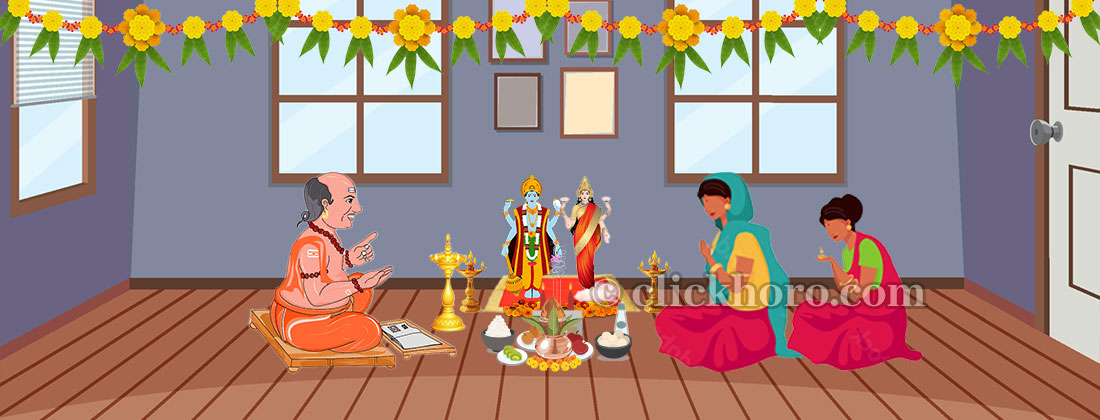
One should wake up early in the morning, perform one's cleansings, and wear clean clothes. Thereafter, one should worship Lord Lakshmi Narayan using incense, lamps, flowers, food offerings (Naivedya), and other ritual items. There are three prescribed
One should wake up early in the morning, perform one's cleansings, and wear clean clothes. Thereafter, one should worship Lord Lakshmi Narayan using incense, lamps, flowers, food offerings (Naivedya), and other ritual items. There are three prescribed methods for observing the Ekadashi fast:
1) Sajala: This entails observing a fast throughout the entire day by consuming only water, and breaking the fast by performing Parana on the following day after sunrise.
2) Safala: This involves a fruit-based diet; one may consume a meal consisting of fruits called Phalahar once, after sunset. The fast is then broken on the following day after sunrise during the Parana period.
3)Nirjala: This involves observing a fast without consuming either water or food; this is considered a very rigorous form of fasting. The fast is subsequently broken on the following day after sunrise during the Parana period.
According to the Hindu calendar, Ekadashi occurs twice every month, marking the 11th lunar day of both the “Shukla Paksha” (waxing phase) and the “Krishna Paksha” (waning phase) as per Moon’s transition. It is a sacred day dedicated to Lord Vishnu. On this day, devotees worship Lord Vishnu by observing a fast, either by abstaining completely from food or by surviving solely on a fruit-based diet. It is believed that observing the Ekadashi fast invokes the divine grace of Lord Vishnu.
Nirjala Ekadashi is observed on the Ekadashi of the “Shukla Paksha” (waxing phase of the moon) during the month of “Jyeshtha Month” to seek the grace of Lord Vishnu and to attain the spiritual merits of all the Ekadashi observed throughout the year. It is considered the most rigorous of fasts, requiring one to abstain completely from both food and water. Subsequently, the fast must be broken the following day during the designated “Parana” period. According to mythological legends, Bhimasena observed this fast; hence, it is also known as 'Bhimseni Ekadashi'.
There is two Ekadashi occur in a month. Thus, the total of 24 Ekadashi come across in 12 months.
Nirjala Ekadashi is the most difficult one. This is because, during all other Ekadashi, you can observe the fast by consuming fruits or drinking water; however, on Nirjala Ekadashi, the fast is observed without consuming any food or water.
There is four most like Ekadashi Nirjala Ekadashi, Amalaki Ekadashi, Devshayani Ekadashi, and Dev Uthani Ekadashi.
Saphala Ekadashi is observed for the sake of success.
If you fall asleep during the day while observing a fast, your fast is considered broken. Whether it is an Ekadashi fast or a Navratri fast.
You may observe it for as many years as you wish. However, according to the “Vishnu Purana”, observing the Ekadashi Fast for at least 11 years is considered meritorious.