
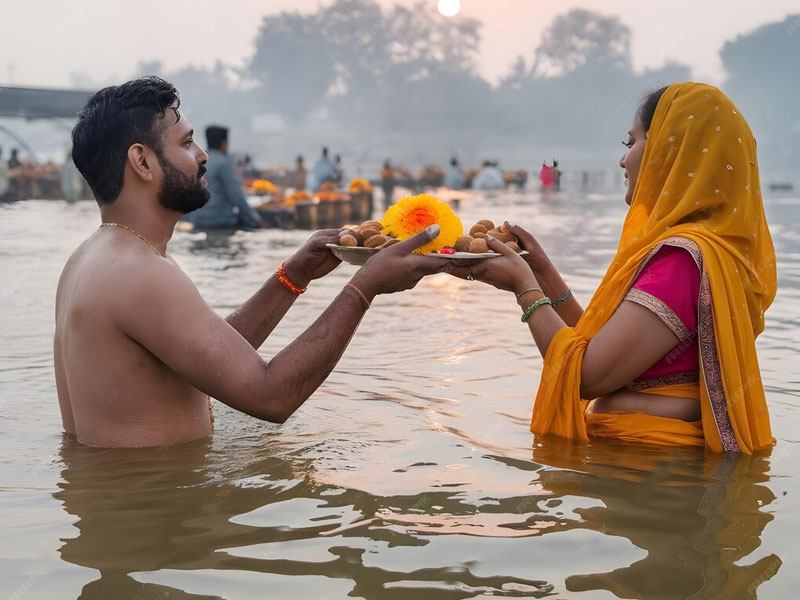
Chhat Puja Significance & Facts
Chhath Puja is a inherited form of Shashti. This festival starts on the Shashti Tithi (sixth day) of the Kartik month Shukla Paksha, five days after Diwali, which falls on the new moon day of Kartik. This is one of the most difficult and important four-day fasts and festivals, starting on the sixth day of the bright fortnight of the Kartik month. That's why it is called “Chhath”.
This festival lasts for four days. On the first day, a meal consisting of rice cooked with rock salt and ghee, and pumpkin vegetable is consumed as prasad (offering), and only one meal is eaten.
The fast begins on the next day. The devotees abstain from food and water throughout the day and in the evening, around 7 pm, they prepare kheer (rice pudding), perform puja (worship), and then consume the prasad, which is called Kharna.
On the third day, offerings of milk are made to the setting sun. On the last day, offerings are made to the rising sun. Special attention is paid to purity during the puja; garlic and onions are prohibited. Devotional songs are sung in the houses where this puja is performed. Finally, the prasad of the puja is distributed to the people.
Chhath is a very big festival, especially in Bihar and Uttar Pradesh. Nowadays, wherever Bihari people live, they celebrate Chhath Puja, whether in India or outside India. The significance of Chhath Puja is immense; this fast has been observed for centuries, and people celebrate it with great joy.
It is believed that women who observe the Chhath fast are blessed with a son. Women generally observe this fast for the desire of a son and for the well-being of their sons. Men also observe this fast with complete devotion for the fulfilment of their wishes.
In the Chhath festival, the Chhath fast is of great importance, resembling a rigorous penance. This Chhath fast is mostly observed by women; some men also observe this fast. Women who observe the fast are called Parvaitin. During this four-day fast, the observer has to fast continuously.
Along with food, comfortable bedding is also given up. In the room prepared for the festival, the observer spends the night on the floor with only a blanket or sheet. People participating in this festival wear new clothes. It is mandatory for those observing the fast to wear clothes that have no stitching.
Women wear sarees and men wear dhotis during Chhath Puja. So, let's understand in details about what happens during these four days of fasting and how people of North India celebrate the Chhath festival.
First Day - Nahay-Khay
The first day of the Chhath festival, known as 'Nahay-Khay', begins on the fourth day of the bright half of the lunar month of Chaitra or Kartik (Kartik Shukla Chaturthi Tithi). First, the house is cleaned and purified. After that, the devotees take a bath in the nearby Ganges River, a tributary of the Ganges, or a pond.
On this day, the devotees carefully cut their nails, wash their hair thoroughly with clean water, and then bathe. While returning, they bring back Ganges water, which they use for cooking. They keep their surroundings clean and tidy. Devotees eat only once on the day. The meal consists of pumpkin curry, mung bean and chickpea lentils, and rice. Fried puris, parathas, and other vegetables are strictly prohibited.
This food is prepared with a very pure and pious feeling; the food is considered prasad (offering) and is not like a normal day's meal. The food is prepared in a traditional way, meaning it is cooked in bronze or clay pots. Instead of gas, mango tree wood and a traditional clay stove are used for cooking. You know, I'm not Bihari, but as a Hindu, I can feel how sacred and difficult this fast is.
Once the food is prepared, the devotee first offers it to the deity, then eats, and only then do other family members eat.
Second Day – Kharna
The second day of the Chhath festival, known as Kharna or Lohanda Chhath, is celebrated on the fifth day of the bright half of the lunar month of Kartik Month. On this day, the devotees keep fast all the day. On this day, the devotees do not even consume a single drop of water before sunset, let alone food.
In the evening, devotee make kheer (rice pudding) is made using rice, jaggery, and sugarcane juice. Salt and sugar are not used in the preparation of this food. These two items are again offered to the Sun God as Naivedya (offering), and then the devotees consume them in solitude in the same house. All the family members leave the house at that time when devotee eat prasad so that there is no noise should be raised.
There's another thing, if someone calls them or speaks loudly while they are eating, they immediately leave their food and get up. This means that once they get up after being told to, they don't sit down again to eat. This is because hearing any kind of noise while eating in solitude is against the rules of the festival for those observing the fast.
Third Day - Sandhya Arghya
The third day of Chhath Puja, known as Sandhya Arghya, is celebrated on the sixth day of the bright fortnight of Chaitra or Kartik. Throughout the day, everyone prepares for the puja together. Special offerings for Chhath Puja, such as Thekua (made from rice flour, jaggery, and ghee), and rice ladoos (also called Kachwaniya), are prepared.
A bamboo basket called a Daura is used to carry the puja offerings and fruits, which are then placed in the Deokari (a designated area for worship). After performing the puja there, in the evening, a man from the family carries the Daura, containing a coconut, five types of fruits, and other puja items, to the Chhath Ghat (riverbank).
To prevent it from becoming impure, it is carried above the head. On the way to the Chhath Ghat, women usually sing regional folk songs related to Chhath Puja. Upon reaching the river or pond, the women sit on a platform built by a family member. They take mud from the river and place all the puja items on the Chhath Mata's platform, offer a coconut, and light lamps.
A little before sunset, they take all the items for worshipping the Sun God, stand in knee-deep water, offer Arghya to the setting sun, and perform five circumambulations.
This day is harder than the other days because, firstly, they are fasting and don’t take even a drop of water, and secondly, in the cold Kartik month, they have to perform all the puja rituals while standing in the water for hours.
Fourth Day - Usha Arghya
On the fourth day, the morning of Kartik Shukla Saptami, offerings are made to the rising sun. Before sunrise, the devotees reach the ghat to worship the rising Sun God, and their family members and relatives are present, just as they were in the evening. The dishes offered during the evening arghya are replaced with new ones, but the roots, tubers, and fruits remain the same.
All the rules and rituals are the same as the evening arghya. The only difference is that the devotees stand in the water facing east and worship the sun. After the completion of the worship, the ghat is worshipped. After distributing the prasad among the people present, the devotees return home and distribute the prasad to their family members and neighbours too.
Upon returning home, the devotees go to the village's peepal tree, which is called Brahma Baba, and perform worship there. After the worship, the devotees break their fast by drinking a sherbet made of raw milk and eating some prasad. This is called Parana or Parna, which means that on this day, the devotees break their fast. The devotees, who have been observing a waterless fast since the day of Kharna, eat a meal containing salt for the first time this morning.
The most important thing is that if someone in a family observes the Chhath fast, they will continue to do so until a new generation in the family is old enough to observe the Chhath fast. According to Sanatan Dharma, if there is a death in the family or extended family, this festival is not celebrated.
Why and How is an Offering made to the Sun God During Chhath Puja? It is believed that the Chhath festival originated during the Mahabharata period. The first to worship the Sun God was Karna, the son of the Sun God.
Karna was a devout follower of Lord Surya. He would stand in waist-deep water for hours every day, offering prayers to the Sun God. It was through the grace of the Sun God that he became a great warrior. This same method of offering prayers is still prevalent in Chhath Puja today.
Some stories also mention Draupadi, the wife of the Pandavas, worshipping the sun. She regularly worshipped the sun for the good health and long life of her family members.
Is Chhath Puja a part of India's Devotional and Spiritual Heritage?
Yes, the most important aspect of Chhath Puja is its simplicity, purity, and connection to folk traditions. This festival, full of devotion and spirituality, uses bamboo baskets, earthen pots, sugarcane juice, jaggery, and offerings made from rice and wheat, accompanied by melodious folk songs, spreading the rich sweetness of folk life.
Chhath Puja Folk Songs
On various occasions during Chhath Festival, such as while preparing the offerings, during Kharna, while going to offer prayers, at the time of offering prayers, and while returning home from the ghat, many melodious and devotional folk songs are sung. I am sharing one of them with you; please take a look.
केलवा जे फरेला घवद से, ओह पर सुगा मेड़राय
काँच ही बाँस के बहंगिया, बहंगी लचकत जाए'
सेविले चरन तोहार हे छठी मइया। महिमा तोहर अपार।
उगु न सुरुज देव भइलो अरग के बेर।
निंदिया के मातल सुरुज अँखियो न खोले हे।
चार कोना के पोखरवा
हम करेली छठ बरतिया से उनखे लागी।
I've never seen Chhath Puja, but I worship Lord Surya daily that’s why I can imagine how it will be complicated. I also worship Surya Dev every Sunday during the Pausha Month, which is why I like Chhath Puja so much, because it's dedicated to Lord Surya.
I've collected some stories about Chhath Puja from my friends they are from Bihar basically and prepared this information for you. If there might be some mistakes or omissions. I request that if you have more information about Chhath Puja, please share it with us in the comment box.




0 Comments
Leave a Reply
Your email address will not be published. Required fields are marked *