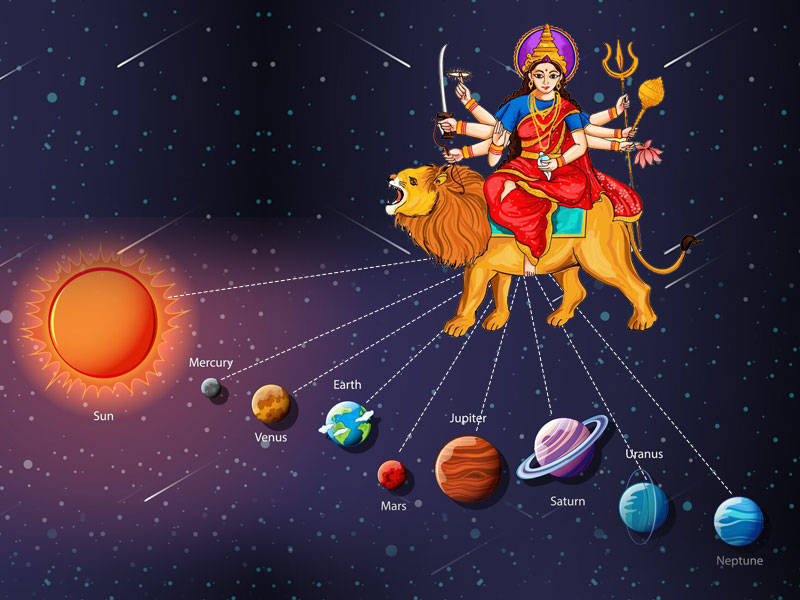
Dasha Mahavidyas Associated with Nine Planets

Dasha Mahavidyas Associated with Nine Planets
| Added by: Astro Editorial Team

Dasha Mahavidyas Linked with Nine Planets

According to Vedic astrology, there are nine planets in astrology: Sun, Moon, Jupiter, Mars, Venus, Mercury, Saturn, Rahu, and Ketu. These nine planets are associated with the ten Mahavidyas in some way. Here, we will discuss how these planets are connected to the Mahavidyas and the significance of this connection.

  • Sun: Matangi
  • Moon: Bhuvaneshwari
  • Mars: Bagalamukhi
  • Mercury: Shodashi
  • Jupiter: Tara
  • Venus: Kamala
  • Saturn: Kali
  • Rahu: Chhinnamasta
  • Ketu: Dhumavati

Sun Associate with Matangi Mahavidya

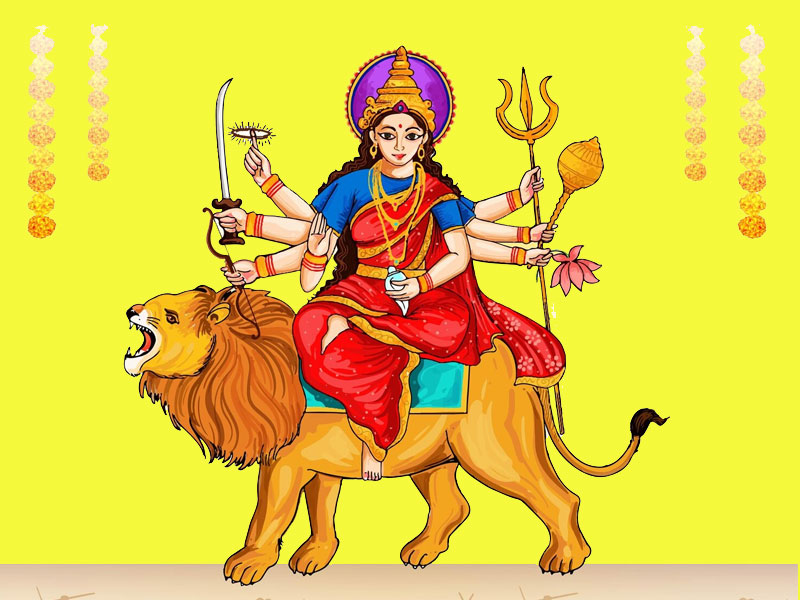
If the Sun is weak or afflicted in the birth chart, or if there are combinations of Sun-Rahu, Sun-Ketu, or Sun-Saturn, then worshipping Goddess Matangi Mahavidya is beneficial to mitigate the negative effects of these planetary influences.

Moon Associate with Bhubanesvari Mahavidya

For mental peace, happiness, concentration, good sleep, and to counteract the negative effects of a weak Moon or its conjunction or aspect with malefic planets like the Sun, Mars, Saturn, Rahu, and Ketu, one should worship Goddess Bhuvaneshwari Mahavidya.

Shani Associate with Kali Mahavidya

To avoid the negative effects of Shani Dosha, Shani's Dhaiya, or Sade Sati, worshipping Goddess Kali is the best solution. Kali is a fierce goddess, and it is said that worshipping a fierce deity or their corresponding god is the right way to counteract the effects of malefic planets, just as iron is used to cut iron. Similarly, worshipping Goddess Kali reduces the negative influence of the planet Saturn.

Mercury Associate with Tripura Sundari Mahavidya

Individuals with a weak position of Mercury in their birth chart should worship Goddess Shodashi or Tripura Sundari Mahavidya. Mercury is very important in the horoscope because if Mercury is weak, the native's intellect suffers. And when the intellect is impaired, what is left in life?

Jupiter Associate with Tara Mahavidya

Individuals with a weak position of Mercury in their birth chart should worship Goddess Shodashi or Tripura Sundari Mahavidya. Mercury is very important in the horoscope because if Mercury is weak, the native's intellect suffers. And when the intellect is impaired, what is left in life?

Shukra Associate with Kamala Mahavidya

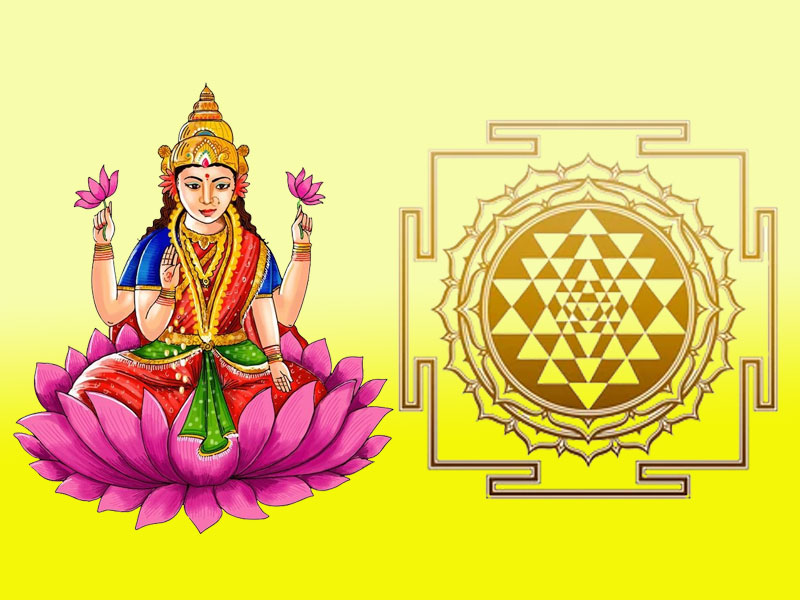
Venus, or Shukra, is associated with wealth, money, luxury, a happy married life, a happy life partner, home, servants, and everything else that contributes to a good life, all of which are influenced by the position of Venus in one's horoscope.

If Venus is afflicted, the person will face struggles in life and may live like a miser. In such a situation, one should worship Mahavidya Kamala, as she is the presiding deity of the planet Venus.

Mars Associate with Baglamukhi Mahavidya

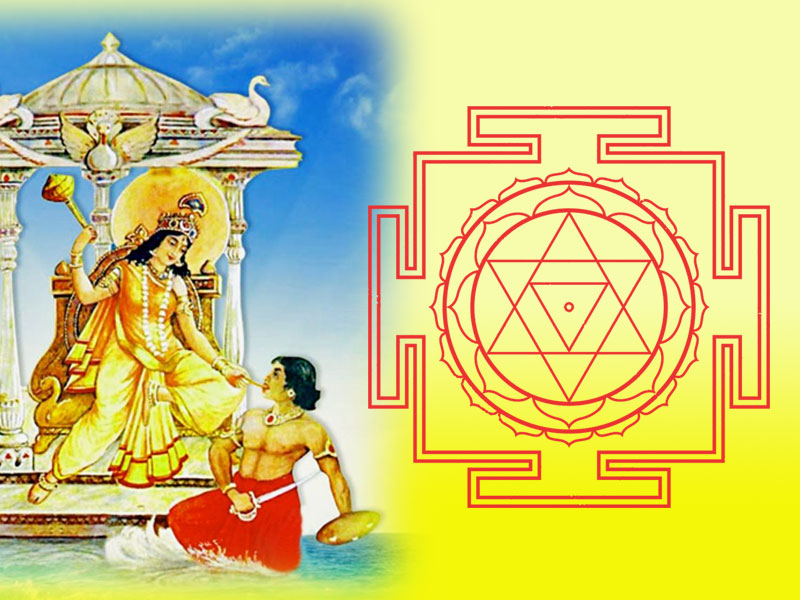
Mars is a hot and malefic planet. If Mars is giving malefic results in the horoscope, or if it is in a malefic conjunction, such as with Rahu or Saturn, then Mars gives very negative results.

Individuals should worship Goddess Baglamukhi Mahavidya to mitigate the negative effects of Mars. Nowadays, there are many Baglamukhi temples and many practitioners of this worship. You can visit any Baglamukhi temple and perform a special puja for Mars to reduce its negative effects.

Rahu Associate with Chhinnamasta Mahavidya

Rahu means full of desires. Because Rahu has no body, only a head, no matter how many desires Rahu fulfils, he is never satisfied. Rahu is a purely malefic planet; wherever it is placed in the horoscope, it will inevitably give malefic results, there is no doubt about it. To appease Rahu and achieve material success, one should worship Goddess Chhinnamasta Mahavidya.

Ketu Associate with Dhumavati Mahavidya

Ketu associate with Dhumavati Mahavidya she is the ruler of the planet Ketu. Dhumavati has a terrifying appearance. However, to gain Ketu's blessings, you must worship Dhumavati. Worshiping her leads to salvation.

Worshiping any of the Mahavidyas also leads to salvation in last part of life. Worshiping Dhumavati destroys enemies, removes disease and poverty. If someone is under the influence of mantras, tantras, or black magic, or if a negative spirit is haunting their home, worshipping Dhumavati can ward them off.

Lagna(Ascendant) Associate with Bhairavi

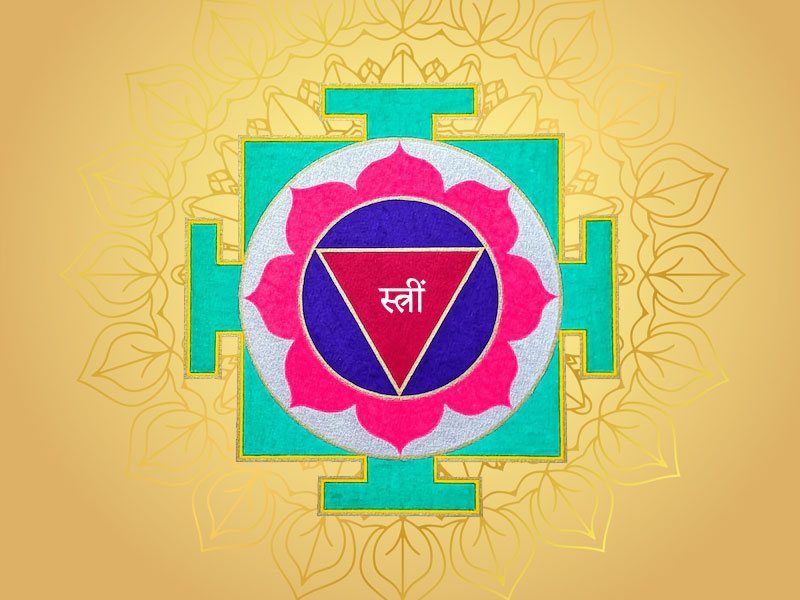
Those with a weak ascendant (meaning a lagna less than 10 degrees) should worship Bhairavi Devi to strengthen their ascendant. If the ascendant lord is debilitated, Rahu is placed in the ascendant, or the ascendant lord is in the eighth or twelfth house of the birth chart, they should worship Bhairavi Devi.

Frequent Asked Questions(FAQs)

The Sri Yantra, is a divine geometric diagram often referred to as the Yantra Raj (King of Yantras) that is considered, within Hinduism, to be the most powerful and supreme symbol of wealth, prosperity, fortune, and power. The Sri Yantra is regarded as the abode of Goddess Mahalakshmi. Its title, “Yantra Raj“, signifies that among all the yantras existing in the world, the Sri Yantra is the most unique and preeminent.

First and foremost, to undertake the Sri Yantra Sadhana, one must receive Guru Diksha (initiation) from a spiritual teacher. A true Guru is someone who is already an expert in and highly experienced with the practice of Sri Yantra Sadhana. The practice associated with the Sri Yantra is considered to be profoundly esoteric and immensely powerful. This Sadhana places primary emphasis on meditation, mantra chanting, and mental concentration. You can perform this practice at home by strictly adhering to specific rituals and guidelines; however, the actual practice of the Yantra Sadhana must be conducted under the direct guidance of the Guru from whom you received your initiation.

While it is true that some people do attempt Sri Yantra Sadhana without a Guru, doing so means you will not receive accurate or complete information regarding the practice. Consequently, achieving success in the Sadhana becomes extremely difficult and often significantly delayed.

Bagalamukhi is the eighth of the ten Mahavidyas (Great Wisdom Goddesses). Goddess Bagalamukhi is also known as Pitambara. Her Sadhana involves the exclusive use of yellow-colored items such as yellow clothing, a yellow prayer mat (Asana), a rosary made of turmeric beads, yellow food offerings (Prasad), and yellow flowers. The Sadhana of Goddess Bagalamukhi is performed specifically to achieve the Stambhan (paralysis or immobilization) of one's enemies. In other words, this Goddess is worshipped to attain victory over adversaries, as well as to find deliverance from difficult times and dangerous diseases. However, one should never attempt Bagalamukhi Sadhana without a Guru; a Guru provides the proper rituals, timing, and procedural guidance necessary to steer the practitioner in the correct direction and ensure their ultimate success.

Bagalamukhi Sadhana is undertaken in situations involving the destruction of enemies, grave calamities, or incurable diseases. For a practitioner (Sadhak) who performs Bagalamukhi Sadhana, enemies do not even dare to wander anywhere near them. Ultimately, Goddess Bagalamukhi bestows upon the practitioner the four goals of human life:

Dharma (righteousness),

Artha (wealth/prosperity),

Kama (fulfilment of desires), and

Moksha (liberation).

Goddess Tara is the second Mahavidya of the ten Mahavidyas. It is said that Tara Sadhana yields spiritual attainment (Siddhi) very rapidly, provided the practitioner finds a true Guru. Goddess Tara is also known as Maha Tara; she is a form of Goddess Kali and is also referred to as Bhadrakali, as she represents the serene and peaceful aspect of Goddess Kali. By performing Tara Sadhana, the practitioner attains Dharma, Artha, Kama, and Moksha. The practitioner receives everything in life that they desire. Typically, this Sadhana is performed at a cremation ground (Smashan Ghat) after midnight (12:00 AM). Tara Sadhana is practiced in two distinct ways: the first is the Vamapaksha (Left-Hand Path), wherein the Goddess is worshipped using Tamasic (fierce/intense) rituals a method often adopted by Naga Sanyasis. The second is known as the Dakshina Paksha (Right-Hand Path); in this method, the Goddess is worshipped with a Sattvic (pure/gentle) attitude a practice commonly followed by Buddhists. Tara Sadhana is a form of Tantric practice performed according to the Kaulachara tradition.

Through Tara Sadhna, a Sadhak (spiritual aspirant) attains Dharma (righteousness), Artha (wealth/prosperity), Kama (fulfillment of desires), and Moksha (liberation). Whatever the Sadhak wishes for, they invariably receive.

Performing Tara Sadhna without a Guru is akin to learning to drive a car without a driver. A Guru can guide you along the correct path, ensuring you reach your spiritual goal without any risks.

Bhairava, an incarnation of Lord Shiva, acts as the guardian of the Divine Feminine Power (Shakti). In ancient times, people would perform Mahavidya Sadhna to acquire immense power, which they would subsequently misuse. Consequently, Lord Bhairava "sealed" (Kilit) the mantras of the 10 Mahavidyas meaning. Lord Bhairav bound their power. This implies that if anyone attempts to perform the Sadhna of any Mahavidya, they cannot do so without the explicit permission of Lord Bhairava. Fundamentally, wherever Shakti resides, Shiva is also present; and wherever the Mahavidyas are found, Lord Bhairava is there to guide them.

Bagalamukhi Sadhna is performed using a rosary made of yellow Hakik (Agate) or a rosary made of turmeric beads.

For Japa during the Sadhna of Tara Mahavidya, a Rudraksha rosary is considered the best option.

The Sri Yantra is hailed as the Yantra Raja because, within the realm of Yantras, it is regarded as the supreme and most exalted of all. If you wish to perform the Sadhna of the Ten Mahavidyas or specifically that of Lalita Sundari you can do so solely by utilizing the Sri Yantra; there is no need to acquire a separate, specific Yantra for each deity.

Shree Yantras are of three types:

1) Bhu Prastha Shree Yantra: This form is completely flat and is typically engraved onto a plate made of gold, silver, or copper. It is considered ideal for performing puja (worship) in a standard household setting.

1) Kurmaprastha Shree Yantra: In this form, the Shree Yantra appears in a 3D form lightly raised upwards resembling the curved shell of a tortoise (Kurma). It is crafted from gold, copper, silver, or Ashtadhatu (an alloy of eight metals). This variant serves to eliminate Vastu Doshas (architectural or spatial defects) within a home and is highly suitable for daily worship.

3) The Meruprastha Shree Yantra: Visually, it resembles a pyramid structure specifically, it looks like Mount Meru. It is extremely powerful and highly energetic. The Meruprastha Shree Yantra is considered the very best among all variants.

Upon bringing the Shree Yantra home, it should be installed in the North-East direction of the house. This is because this direction is known as the "Aishanya Kona" (the Ishana corner), a direction ruled by the planet Jupiter. The prescribed procedure involves purifying the Yantra; bathing it with raw milk, Gangajal (water from the Ganges), and Panchamrit (a sacred mixture of five ingredients); performing Prana Pratishtha (the ritual of infusing life force into the Yantra); worshipping it through Shodasopachar (the sixteen-step ritual); and engaging in meditation, acts of charity (Daan), followed by a sacred fire ritual (Havan) and the chanting of mantras.

If you wish to energize the Shree Yantra within your home, it is advisable to invite a dedicated Sadhak (spiritual practitioner) of the Shree Yantra to perform the installation, as they possess complete knowledge of the intricate rituals involved. Conversely, if you simply invite a standard priest, they may merely perform a routine Puja and depart, as they often lack sufficient expertise regarding the specific rituals and procedures associated with Yantras.

Yes, one may perform the worship and chant the mantras of any Goddess while seated before the Shree Yantra. This is because the Shree Yantra is revered as the Yantra Raj, the King of all Yantras.

Yes, the Shree Yantra is indeed worshipped within the home. However, it is crucial to bear in mind that performing daily worship of the Shree Yantra according to the prescribed rituals is mandatory. Failure to do so will result in the Yantra lacking its inherent energy, and consequently, it will be unable to yield the desired results effectively.

Shree Yantras can be crafted in Gold, Copper, or Ashtadhatu (an alloy of eight metals) are considered to be the most auspicious and superior.

Tara Tantra Sadhana is practiced in accordance with the Shakta tradition of the Hindu faith. Buddhist Tara Sadhana is primarily practiced in accordance with the traditions of Tibetan Buddhism and the Vajrayana path. Goddess Tara is revered as the deity of supreme wisdom that profound knowledge which reveals the mysteries of the universe. While Tara Tantra Sadhana is often performed using the Kaulachara method with some practitioners seeking to attract specific outcomes, dispel negative influences, attain liberation (Moksha), or acquire supreme wisdom Buddhist Tara Sadhana has a distinct objective: Enlightenment. This is the very state of illumination attained by Lord Buddha; practitioners of this path are unconcerned with Siddhis (supernatural powers) or the material pleasures of the mundane world.

1) A renowned Bagalamukhi temple is situated in Nalkheda, Madhya Pradesh, approximately 100 kilometers from Ujjain.

2) In Kangra, Himachal Pradesh, there is a place called Bankhandi, which houses a famous Shakti Peeth dedicated to Goddess Bagalamukhi.

1) In the Birbhum district of West Bengal, there stands a famous temple dedicated to Goddess Ugratara. Legend has it that Maharishi Vashistha worshipped the Mother Goddess at this very site during his spiritual sadhana (practice). This temple is recognized as a prominent Shakti Peeth.

2) In Odisha, there is a village named Bhushandapur, situated alongside National Highway 16 (connecting Bhubaneswar to Berhampur). This temple is renowned for both its beauty and its historical significance. Known as the Ugratara Shakti Peeth, the shrine was established by King Bhanu Dev of Puri in the 13th century. He consecrated the Goddess at the borders of his kingdom to seek protection against external invaders.

During the Mughal era, invaders sought to locate and demolish this temple; however, as the shrine is nestled amidst hills and dense forests, they were unable to discover the actual route. Consequently, mistaking a Lakshmi temple located a short distance away for the Ugratara temple, they proceeded to demolish the former instead.

0 Comments

Leave a Reply

Your email address will not be published. Required fields are marked *