
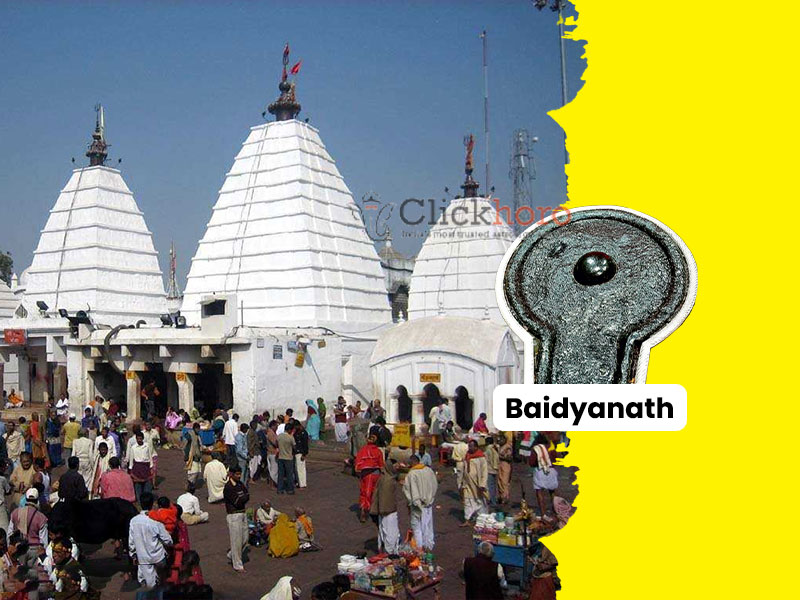
When is the Vaidyanath Jyotirlinga Worshipped?
The Vaidyanath Dham was built in the 8th century AD. The temple was maintained during the reign of the last Gupta emperor, King Aditya Sena Gupta. The Mughals did not touch the temple, and Mughal Emperor Akbar's brother-in-law built a pond near the temple in Deoghar, known as Mansarovar. Believed that, some muslims also worshipped Vaidyanath Baba, as the temple maintained its importance even during Muslim rule in India.
Why is the Temple's Structure Different from Hindu Temples?
If you pay attention to the temple's structure, it appears to resemble a pyramid. The gold plating on the temple was donated by Raja Purna Singh, the Maharaja of Gidhaur. Five trident-shaped knives, called Panchsulas, and an eight-pointed lotus gem, called the Chandrakanta Mani, were also donated by Raja Purna Singh.
Baba Baidyanath Jyotirlinga is the 10th Jyotirlinga
Baba Baidyanath is considered the 10th among the 12 Jyotirlingas. Located in Deoghar in the Santhal Pargana region of Jharkhand, this temple is visited by millions of devotees every year. Baidyanath Jyotirlinga is one of the 12 sacred Jyotirlingas of Lord Shiva and its story is also very unique, which we will tell in detail later.
The place where Baba Baidyanath ji's temple is located is also known as Baba Baidyanath Dham. This place has great spiritual significance and is considered a powerful place for worship and healing. It is very crowded during the month of Shravan, Shivratri and Sankranti. Every year, millions of devotees come to visit Lord Baidyanath.
The Story of Baba Bidyanath Jyotirlinga
According to mythology, you know that there was no greater devotee of Shiva than Ravana. He went to the Himalayas and performed severe penance to appease Lord Shiva. During his rigorous penance, he cut off his nine heads one by one and offered them to the Shivalinga. When he was about to cut off his last head, Lord Shiva, pleased, appointed him to the position of head of the human race.
Ravana then asked Shivaji for a boon: "Oh Lord of the Gods, Mahadev! I want you to come with me and live forever in my Lanka. I will serve you with all my heart, mind, and wealth. I will not let anything go wrong in your worship." Then Shivaji said, "Tathasthu," meaning, "I accepted Ravana's request."
He said, "So I will go with you, because you are such a great devotee of mine. Who else can care for me more than you? But there is one condition: you will take me with you. But wherever you place me on the land once, I will become established there." Then Shivaji transformed into a linga, and Ravana happily picked up the linga and departed.
Because who is taking Mahadev, the God of Gods, to his Lanka. Seeing this, the other Gods like Indra, Varuna, Agni Dev, Brmha Dev etc. are showed great tension. Everyone said what should be done now, if Mahadev stays in Lanka, then how will things work. Thinking this, everyone went to Lord Vishnu and prayed that this is not under the control of the universe.
How can Lord Mahadev stay in Lanka? Lord Vishnu asked all the Gods like Brahma Ji, Indra Dev, Varun Dev, Vayu Dev, Agni Dev etc. to have patience and said that I will think of some solution for this. What happened then?
Brother, what else was to happen? Lord Vishnu, all this is his play and he is the creator of this universe, he can do anything he wants.
Ravana was carrying the idol through the sky when suddenly he felt the urge to urinate. He tried to control himself and remembered Lord Shiva's words, which he had said would establish him wherever he placed it. He felt the urge to urinate. He said, "No matter what happens, I can't place it anywhere else.
I have attained Shivaji through so much penance, and I can't make such a mistake." But gradually, the urge to urinate grew stronger. Ravana wondered, "What should I do now? I can't put it down, and I can't urinate while holding Shivalinga in my hands. So, what should I do?"
Then suddenly, the urge to urinate became so strong that it was difficult to hold it back. He forgot everything for a moment. He saw a man, an Ahir Jat coming towards him. He handed him the lingam and went to relieve himself, telling him not to place it down. But because the lingam was so heavy, the Ahir placed it on the ground. The lingam remained motionless there.
After urinating, when he thought about it, he looked down at the Shiv Linga and asked, what did you do with this? I had told you not to put it down and you put it down? The Ahir said, Maharaj! I could not bear its weight, so I was forced to put it down. There was not ultimate choice for me.
Then when Ravana lifted it, why did the Shiv Linga get up? It became motionless there itself because it was the words of Lord Shiva. Then he bowed to Shivaji and said, Hey! Mritnjaya, Hey Devon ke Dev Mahadev! I can understand everything, this is all your play, saying this then Ravana went towards his Lanka.
The place where Ravana had kept the Linga is in Deoghar of Jharkhand, today the same Lingam is known by the name of Baba Baidyanath Jyotirlinga.
Ravana offered each of his heads to Shivaji during worship. Lord Shiva reattached all his heads, acting as a physician. That is why he is known as Vaidyanath. The term “Vaidya” means doctor, and he is the doctor of doctors. It is believed that worshipping and anointing Lord Vaidyanath here provides relief from all ailments and diseases, no matter how serious.
Baba Baidyanath is also mentioned in the Koti Rudra Samhita
The story of Shri Vaidyanath Jyotirlinga is written in the Koti Rudra Samhita of the Shri Shiva Mahapuran as follows: The demon king Ravana was not only arrogant but also quick to express his ego.
Once, he was worshipping Lord Shiva with devotion on Mount Kailash. When Lord Shiva was not pleased with him even after many days of worship, he again resorted to a different method of penance. He dug a hole in the densely tree-filled forest south of the Siddhisthal Himalayas and prepared a sugarcane.
Ravana, the pride of the demon clan, established a fire in the pit and began performing havans and offerings. He also installed Lord Shiva there beside him. For his penance, he adopted strict discipline and discipline.
During the summer, he would consume fragrant Panchagni (five fires) between five fires. During the rainy season, he would sleep on a platform in the open field, and during the winter, he would stand in water up to his neck.
Ravana's penance continued through these three practices. Despite his rigorous austerities, Lord Maheshwara was not pleased. It is said that, it is very difficult for an evil spirit to appease the Lord. When Ravana's rigorous austerities failed to yield results, he began worshipping Lord Shiva by cutting off his heads one by one.
He would worship the Lord according to the scriptures, and after that worship, he would cut off one of his heads and offer it to the Lord. Thus, he cut off nine of his heads. When he was about to cut off his final tenth head, the devotee-loving Lord Maheshwara became pleased and pleased with him. He appeared in person and restored all of Ravana's heads, restoring them to their original state.
The Lord granted the demon king Ravana unparalleled strength and valor, as desired. After receiving Lord Shiva's blessings, he bowed down and humbly folded his hands and said, "Lord Shiva, be pleased with me. I have come to your shelter and will take you to Lanka. Please grant my wish."
Hearing Ravana's words, Lord Shiva was thrown into a state of confusion. To avert the moral dilemma, he reluctantly said, "King of demons, take this excellent lingam of mine to your capital with devotion, but remember: if you place it on the ground on the way, it will become immovable there. Now do as you wish." When the lingam became fixed there, driven by a sense of public welfare, Ravana, disheartened, departed for his capital.
Upon reaching the capital, he recounted the entire incident to his wife, Mandodari. Indra and other deities and sages, hearing the news of the lingam, consulted among themselves and arrived there. Due to their unwavering devotion towards Lord Shiva, they worshipped the Linga with utmost joy as per the prescribed rituals.
There are many stories in the Shiva Purana which tell that Shiva is the lord of physicians. It is said that Shiva assumed a fierce form and severed the head of his father-in-law Daksha with his trident. Later, when there were many requests, Baba Baidyanath searched for the head in all the three worlds but could not find it. After this, he cut off the head of a goat and transplanted it on the body of Daksha.
This is why people worship Mahadev by chanting the sound of a goat, "B,B,B." By blowing the cheek, they make this sound to appease the trained Baba.
So, here is the unique stories shared with you of Baba Baidyanath Ji. Hope you liked it. It is believed that seeing him cures all types of diseases and ailments. If you want to see Baba Ji, you can easily reach him via the location route given below.
By Air
The nearest airport to Baidyanath Jyotirlinga is Deoghar Airport, approximately 12 km away, with direct flights from Delhi, Kolkata, Bengaluru, and Patna. Taxis and auto-rickshaws are available from there to the temple within 15 to 30 minutes. Communication is very easy to go there.
By Train
The nearest major railway station is Jasidih Railway Junction, about 7-10 km from the temple. It is well connected to major cities in India by direct trains like the Rajdhani Express. From Jasidih, you can easily reach the temple by local shuttle, bus, auto-rickshaw, or taxi.
By Road
Several interstate buses run to Baidyanath Dham from Ranchi (250 km), or from Patna (238 km), and Deoghar is easily accessible by road from Kolkata and Bhubaneswar. Private cars, buses, and shared cabs are available to reach Deoghar directly from these cities.


0 Comments
Leave a Reply
Your email address will not be published. Required fields are marked *